
Your AI-Built Site Is Indexed. So Why Isn't Anyone Signing Up?
You fixed the SEO. Google can see your site now. So why is the signup count still zero? Here's the gap nobody talks about.
4 min read
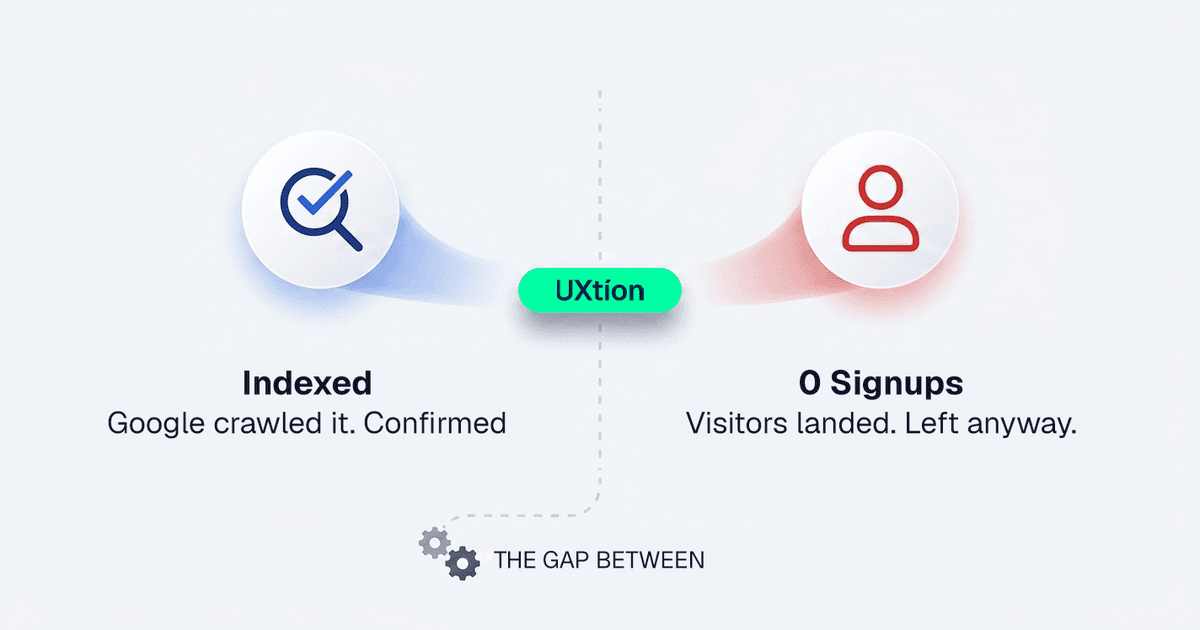
You built your site with Lovable, Bolt, v0, or Cursor. You did the homework — added a sitemap, fixed your meta tags, waited out Google's indexing delay. You checked Search Console and finally saw the green checkmarks.
And then... nothing changed.
Traffic trickles in. Nobody signs up. You start wondering if the SEO fix even worked, so you re-check Search Console again. It did work. Your pages are indexed. That was never actually the problem you needed to solve.
The guide you've been reading stops one step too early
Search for "why isn't my Lovable site showing up on Google" and you'll find dozens of solid guides. They all explain the same root cause: these tools render pages in the browser with JavaScript, so search engines sometimes see an empty shell instead of your content. Fix that, and Google can finally read your page.
That advice is correct. It's also incomplete.
Getting indexed answers the question "can a stranger find this page." It says nothing about "will that stranger sign up once they land on it." Those are two completely different problems, and almost nothing written about AI-built sites addresses the second one.
Indexing gets a machine to see your page. Conversion needs a human to trust it.
A crawler doesn't care if your hero section explains what you actually do. It doesn't notice if your call-to-action button is the same shade as your background. It doesn't hesitate before typing in an email address because there's no name, no photo, no single sentence of proof that a real business is on the other end.
A visitor does all of that, in about four seconds, before deciding whether to stay.
Most AI-built sites ship fast and look clean, but they inherit the same handful of gaps — because the tools that build them are optimized for "generate a working page," not "generate a page a stranger will trust enough to hand over their email."
What's actually costing you signups (check these yourself)
Before you touch another meta tag, open your own site as if you'd never seen it before and walk through this:
- Can you explain what this does in one sentence, without scrolling? If your headline describes a feeling or a vibe instead of a specific outcome, visitors bounce before they understand the offer.
- Is there a single, obvious next step? Not three buttons with different colors competing for attention — one clear action, repeated at the top and the bottom of the page.
- Would a stranger believe a real person runs this? No name, no story, no photo, no single real number (users, reviews, anything) reads as anonymous — and anonymous doesn't get trusted with an email address.
- Does the page tell visitors what happens after they click? "Sign up" with no context asks for a commitment. "See your first result in 60 seconds, no card required" removes the risk of finding out.
- Does it work the same on a phone as it does on your laptop? Most first visits to a new site happen on mobile. If a button is hard to tap or text runs off-screen, that visit ends there.
None of these show up in a Search Console report. All of them show up in your signup numbers.
Why this gap exists in AI-built sites specifically
It's not that these tools produce bad work — plenty of AI-built sites look genuinely polished. The gap comes from what the tools are built to optimize for: producing a working, good-looking page fast. Trust signals, a single clear action path, and copy that answers "what is this" in one line aren't things a prompt naturally asks for — they're things a second pass catches, and a second pass is exactly the step that gets skipped when shipping takes an afternoon instead of a month.
That's not a reason to avoid these tools. It's a reason to run one more pass before you assume the site is done — the same way you'd proofread an email before hitting send, even after spellcheck already passed.
The fix doesn't require starting over
You don't need to rebuild the site or hire an agency. Most of what's listed above is a rewrite of a headline, a repositioned button, or one added line of copy — the kind of change you can make in the same tool you built the site with, in an afternoon.
The hard part isn't making the fix. It's knowing which five things to fix first, out of the dozens of small decisions that make up a page.
That's the gap we built UXtion to close — an audit that looks at your actual page the way a visitor does, and hands you the specific fix to paste back into Lovable, Bolt, or whatever you're already using. No new tool to learn, no rebuild. Run a free check on your site →
Related reading (coming soon): Lovable-specific checklist · Bolt-specific checklist · The trust signals we see missing most often, based on real audits.